
What are the Career Opportunities After Completing a Civil Engineering Degree From Pune Colleges?
Careers after a civil engineering degree include
Why Are Civil Engineering Careers Growing Rapidly in India?
Skills Required to Build a Successful Civil Engineering Career
How Do Civil Engineering Career Paths Compare With Other Engineering Fields?
Why Civil Engineering Graduates Are Crucial for Future Infrastructure Development?
The civil engineering course covers the design, construction, and maintenance of physical infrastructure, including buildings, water and sewage systems, roads, and bridges. It is one of the most sought-after engineering disciplines in India to build a successful career.
Graduates from top civil engineering colleges in Maharashtra, especially in Pune, gain real-world project experience, use industry-standard tools, and learn essential skills in demand across the construction, government, and infrastructure sectors.
Careers after a civil engineering degree include:
- Geotechnical Engineer
- Environmental Engineer
- Design Manager
- Transportation Engineer
- Structural Engineer
- Site Engineer
- Urban Planner
- Construction Project Engineer
Why Are Civil Engineering Careers Growing Rapidly in India?
1. Massive Infrastructure Development: India allocates a significant budget to metro rail, national highways, airports, and smart city projects, which require civil engineers for planning, design, execution, and quality control throughout the project execution.
2. Smart Cities and Urban Expansion: Growing urbanisation requires engineers to plan and build public transit networks, roads, drainage systems, and residential infrastructure to support city expansion.
3. Government Mega Projects: Programmes such as Bharatmala, Sagarmala, the high-speed rail network, and the PM Gati Shakti National Master Plan span multiple decades and require large numbers of civil engineers throughout their duration.
4. Growth in Sustainable Construction: Public and private-sector projects now mandate green-building standards and climate-resilient design. So, there is a strong demand for engineers who understand sustainable construction practices.
5. Private Real Estate and Industrial Projects: Developers building residential townships, commercial complexes, logistics parks, and industrial corridors consistently hire civil engineers for site management, structural design, and project delivery roles.
6. Combat Skill Shortage: There is an urgent need for civil engineers with specialised skill sets and adequate training to keep pace with the speed of infrastructure development.
Skills Required to Build a Successful Civil Engineering Career
A career in civil engineering today requires technical expertise, digital fluency, knowledge of sustainable design, and project management skills. While engineering fundamentals get you into the field, soft skills and leadership capabilities determine how far you go.
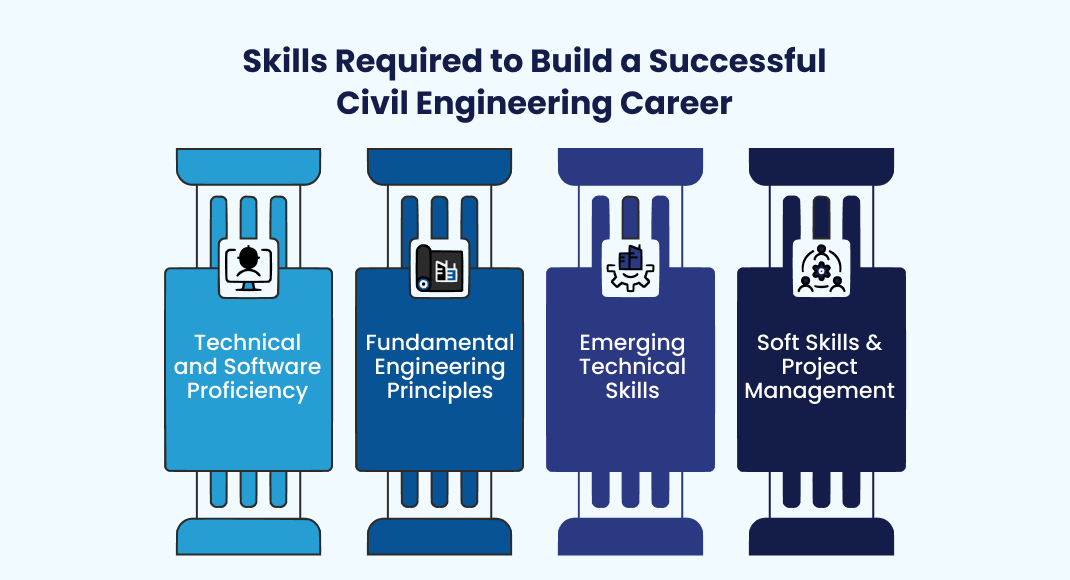
- Technical and Software Proficiency
- Fundamental Engineering Principles
- Emerging Technical Skills
- Soft Skills & Project Management
How Do Civil Engineering Career Paths Compare With Other Engineering Fields?
| Parameter | Civil Engineering | Mechanical Engineering | Electrical Engineering | Computer Science |
|---|---|---|---|---|
| Core Focus | Infrastructure, buildings, transport | Manufacturing, design systems | Power systems & electronics | Software & data systems |
| Industry | Construction & infrastructure | Manufacturing & automation | Energy & utilities | IT & digital technology |
| Skill Requirements | Structural design & site management | Mechanical systems & production | Circuit design & power | Programming & algorithms |
| Leadership Roles | Project Manager / Infrastructure Director | Plant Head | Power Systems Head | CTO / Tech Architect |
| Industry Demand | High in infrastructure growth | High in manufacturing | High in renewable energy | Very high in IT & AI |
Why Civil Engineering Graduates Are Crucial for Future Infrastructure Development?
Growing Infrastructure Investments
India's National Infrastructure Pipeline (NIP) targets over $1.4 trillion in investment for roads, railways, energy, and urban development.
The construction industry contributes approximately 9% of India's GDP.
Urban Population Growth
By 2030, nearly 40% of India's population will live in urban areas.
The exponential growth drives demand for housing, water supply systems, sewage management, transport networks, and public utilities.
Demand for Sustainable Engineering
New standards, such as adopting green building practices, smart transportation planning, and climate-resilient infrastructure, are thus expanding civil engineering job opportunities in India.
Engineers with knowledge of environmental impact assessment and sustainable design methods find opportunities in both government and private sectors.
FAQs
1. What are the highest-paying jobs after a civil engineering degree?
Structural engineers, construction project managers, geotechnical engineers, and transportation planners are among the highest paid in the field. And there are also lucrative opportunities for engineers with expertise in BIM or sustainable design and experience in large-scale infrastructure projects.
2. Are civil engineers in demand in India?
Yes. The National Infrastructure Pipeline, urban expansion, and growing green construction activity sustain consistent demand for civil engineers across public and private sectors. Several specialisations currently face a shortage of supply relative to available positions.
3. Can civil engineering graduates work in government sectors?
Yes. The Public Works Department (PWD), National Highways Authority of India (NHAI), municipal corporations, Indian Railways, and state infrastructure agencies all recruit civil engineers. They need to clear the UPSC and state PSC examinations.
4. Is civil engineering a good career choice in 2026?
Yes. Government infrastructure investment, private real estate growth, and increasing demand for sustainable construction all contribute to a strong job market for civil engineering graduates.
OUR RECENT BLOG