Top M.Tech Mechanical Engineering Specialisations
What are the specialisations available under M.Tech in Mechanical Engineering?
The Benefits of Choosing a Specialisation in M.Tech Mechanical Engineering
Skills Required to Succeed in M.Tech Mechanical Specialisations
How do M.Tech Mechanical Specialisations Compare with other Engineering Streams ?
Why is M.Tech in Mechanical Engineering Relevant for Future and AI-Driven Careers?
Imagine turning on your dryer only to find a tornado in your room. Open your fridge to find that Antarctica has shifted to your home. You start the car, and suddenly, Mars becomes a vacation spot. These are the oops moments of a world without mechanical engineers, in which every system has power and absolutely no manners.
Since we have established that a world without Mechanical engineering would devolve into pure chaos, here’s why an M.Tech in Mechanical Engineering might be the right next step for you. From the specialisations available to why this degree holds its ground in an AI-driven world, here’s everything you need to know.
What are the specialisations available under M.Tech in Mechanical Engineering?
Mechanical Engineering is a field that sits at the intersection of physics, materials science, and mathematics, used to design, analyse, and maintain mechanical systems. It is one of the broadest engineering disciplines in existence and encompasses a vast field with numerous specialisations under it. The most prominent ones being:
- Thermal Engineering
- Design Engineering
- Manufacturing Engineering
- Mechatronics and Robotics
- Automobile Engineering
- Aerospace Engineering
- Marine Engineering
- Fluid Mechanics
- Material Science
The Benefits of Choosing a Specialisation in M.Tech Mechanical Engineering
At the postgraduate level, it gives you something that a bachelor’s degree cannot simply give you: the depth to specialise, to lead and define what comes in your chosen field or domain. So, if you are evaluating M.Tech in Mechanical Engineering, here is everything you need to know, from specialisations offered to why this degree continues to grow in importance even in an AI-driven world.
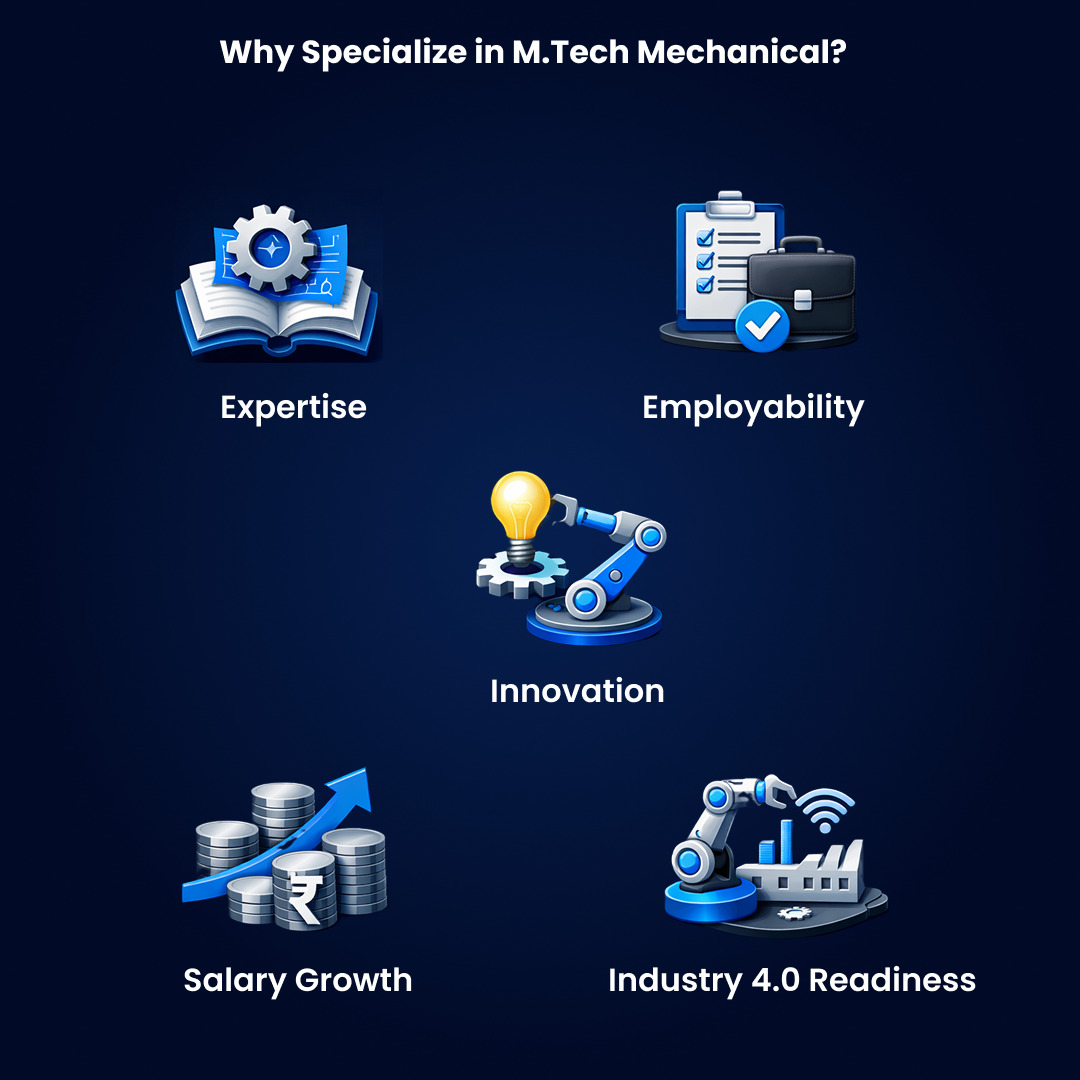
- Deep technical expertise in a focused domain : When you have the ability to focus on a specific area of interest, you stop being a generalist and start building real authority in the chosen domain. You develop a deeper understanding of how things work, the best practices to follow, and the emerging trends to stay ahead of.
- Higher industry relevance and employability: Mechanical engineers have high employability, thanks to their industry-specific expertise and in-depth understanding, making them top choices for employment.
- Better research and innovation: The MTech programme opens a whole new world of exciting career prospects. Without scope for research, there would be no new gadgets or technology.
- Improved salary prospects in niche sectors: Highly specialised niches like robotics or automation, or nanotechnology under materials science, will offer considerably higher compensation due to their transformative and multidisciplinary nature. Depth naturally commands a premium, so the more specific your expertise, the more indispensable you become.
- Stronger alignment with Industry 4.0 trends: The Mechanical Engineering sector is undergoing a monumental transformation that will define how it operates going forward. And the engineers who thrive will be the ones who saw them coming. Smart factories, digital twins, electric mobility and AI-generated manufacturing trends are not future trends; they are present realities reshaping every specialisation on this list. An M.Tech in Mechanical Engineering positions you at the forefront of these changes, which is where you should be in a dynamic field such as this.
What Skills Are Required for M.Tech Mechanical Specialisations?
The right specialisation gets you through the door, but the right skills determine what you do when you are inside and how far you’ll go in your career. Some of the best Mechanical Engineering colleges in Maharashtra, such as MIT AOE, look for these skills and nurture them. Here is what the field actually demands:
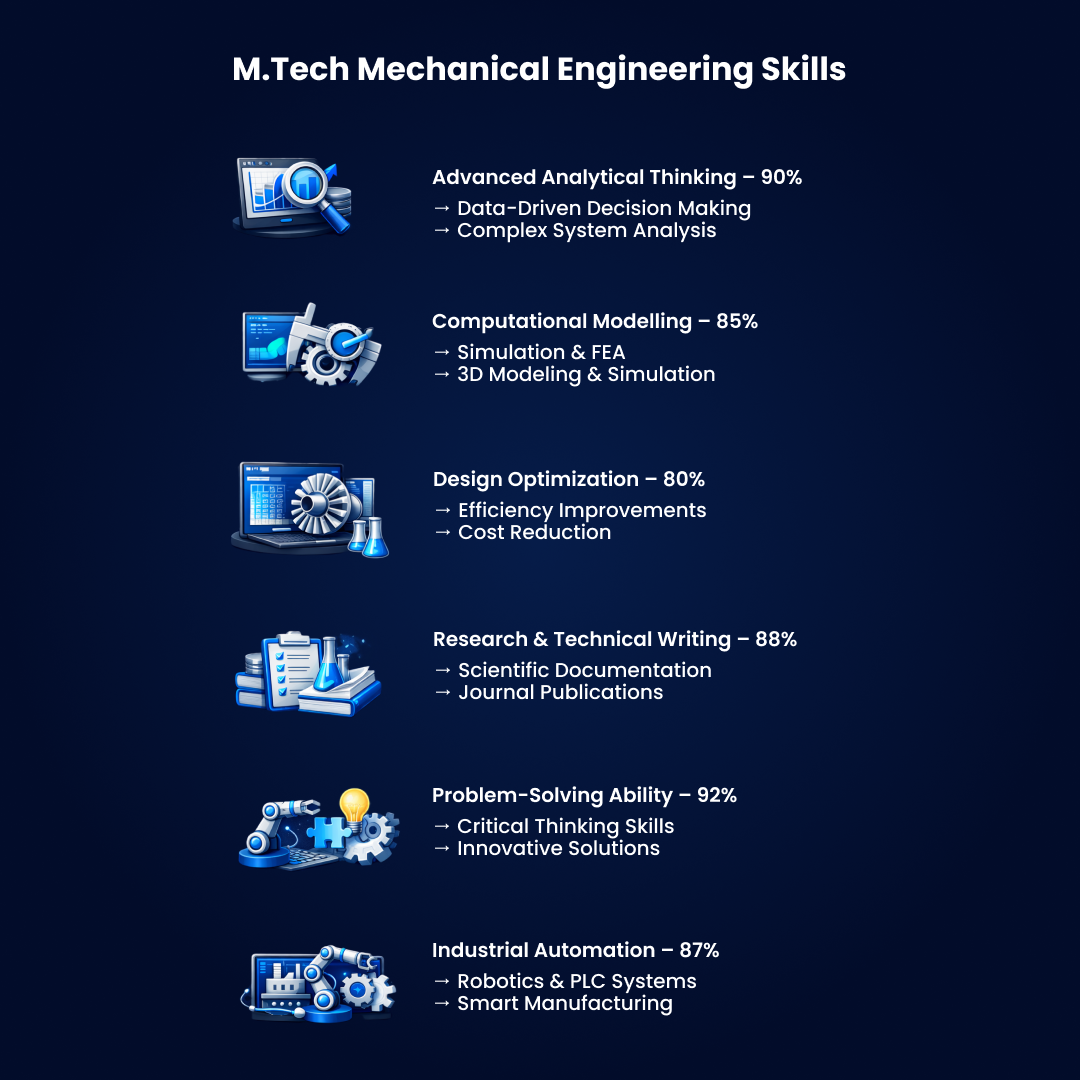
- Advanced analytical thinking - the ability to decompose complex systems into solvable problems
- Engineering mathematics proficiency - mastering mathematical principles is vital for enabling the design and analysis of complex systems and innovating in their fields.
- Simulation and Modelling Skills - this is a non-negotiable since testing in the virtual world is cheaper and more feasible.
- Problem-solving capability - it becomes imperative to identify what is wrong and what to do about it.
- Research-oriented - must have the curiosity along with rigour to go beyond what is known.
- Knowledge of industry software tools - Aspirants must be proficient in ANSYS, Solidworks, AutoCAD or their equivalents, which are the instruments of the discipline.
How do M.Tech Mechanical Specialisations Compare with other Engineering Streams ?
Choosing the right Post Graduate Stream is equally about understanding where each discipline sits in the wider engineering landscape as it is about your personal interests and passions. Here is a quick glance at the comparison table about how MTech Mechanical Engineering courses compare across key parameters:
| Parameter | M.Tech Mechanical | M.Tech Civil | M.Tech Electrical | M.Tech Computer Science |
|---|---|---|---|---|
| Core Focus | Design, analysis and manufacturing of mechanical systems spanning over thermal engineering, robotics, automation, materials science and energy systems | Planning, design and maintenance of built infrastructure including structural, geotechnical, transportation, water resources and environmental engineering | Generation, transmission, and application of electrical energy covering power systems, control systems, signal processing, embedded systems and telecommunications | Development and management of software, hardware, and intelligent systems including data science, cybersecurity, cloud computing and computer architecture |
| Industry Orientation | Automotive, Aerospace, defence, steel, energy, HVAC, and India’s growing EV ecosystem | Construction, Government infrastructure, real estate, smart cities, irrigation, and environmental consultancy | Power utilities, telecom, semiconductor firms, renewable energy and industrial automation | IT majors, Tech MNCs, fintech, health tech, defence tech, AI labs, and virtually every sector undergoing digital transformation |
| Skill Orientation | CAD, FEA, thermodynamics, mechatronics, robotics, Industry 4.0 tools, digital twin modelling and lean manufacturing | Structural analysis, BIM, geotechnical software, project management, AutoCAD, sustainable design and AI aided infrastructure and modelling | Circuit design, MATLAB programming, power electronics, embedded systems, VLSI and renewable energy integration | Programming, machine learning frameworks, cloud platforms, DevOps, data structures, databases and cybersecurity tools |
| Industry Demand | Average M.Tech Mechanical Engineer salary in India is around ₹8.25 LPA with initiatives like Make in India, Smart cities Mission and the push for Atmanirbhar Bharat, demand for skilled mechanical engineers is expected to surge particularly in EVs, robotics, and renewable energy | Civil engineer salary in India goes up to ₹6.6 LPA, with high demand in urban development | M. Tech Electrical Engineering starting salary is around ₹4–8 LPA, with an average of ₹5–10 LPA. Demand is sharply rising with India’s renewable energy push and rapid digitisation across power, telecom, and EV sectors. | M.Tech CSE commands ₹6–20 LPA, the highest earning potential among all the M. Tech branches, driven by demand in software and AI. |
Why is M.Tech in Mechanical Engineering Relevant for Future and AI-Driven Careers?
The short answer is that Mechanical Engineering is not competing with it, but it is just being amplified by it. In 2026, demand for engineers is growing due to industrial modernisation and technological developments, with Mechanical Engineering at the very centre of India’s biggest growth sectors.
As of 2025, India’s total automotive workforce stands at around 19 million professionals, the vast majority of whom possess mechanical expertise. Far from being obsolete, mechanical engineers who embrace the change AI brings, automation, and smart systems are among the most sought-after professionals in India’s industrial future.
By integrating AI across Manufacturing Engineering Technology, we can enhance productivity, strengthen competitiveness, and unlock new opportunities for innovation and entrepreneurship. Our focus is on building an inclusive AI ecosystem that empowers enterprises and MSMEs alike, while preparing India’s workforce for the future.
- Ashwini Vaishnaw (Union Minister for Electronics and Information Technology)
Frequently Asked Questions
What is the best specialisation in M.Tech Mechanical Engineering?
Choosing the best specialisation highly depends on your passion and career goals, but a field with a growing scope is Mechatronics and Robotics.
Does M.Tech in Mechanical Engineering offer good salary growth?
Yes, there is a good salary growth. The average salary is around INR 8.25 LPA, with some niche specialisations exceeding INR 15 LPA. MIT AOE is one of the top Mechanical Engineering colleges in Pune, placement-wise.
Which M.Tech Mechanical specialisation has the highest demand in 2025?
Robotics and Mechatronics is the most sought-after specialisation in recent years.
Is an M.Tech in Mechanical Engineering future-proof in the AI era?
Yes, it will remain future-proof in the AI era, thanks to the transformative impact of AI on the field. It will invite mechanical engineers who can leverage AI technologies.
OUR RECENT BLOG