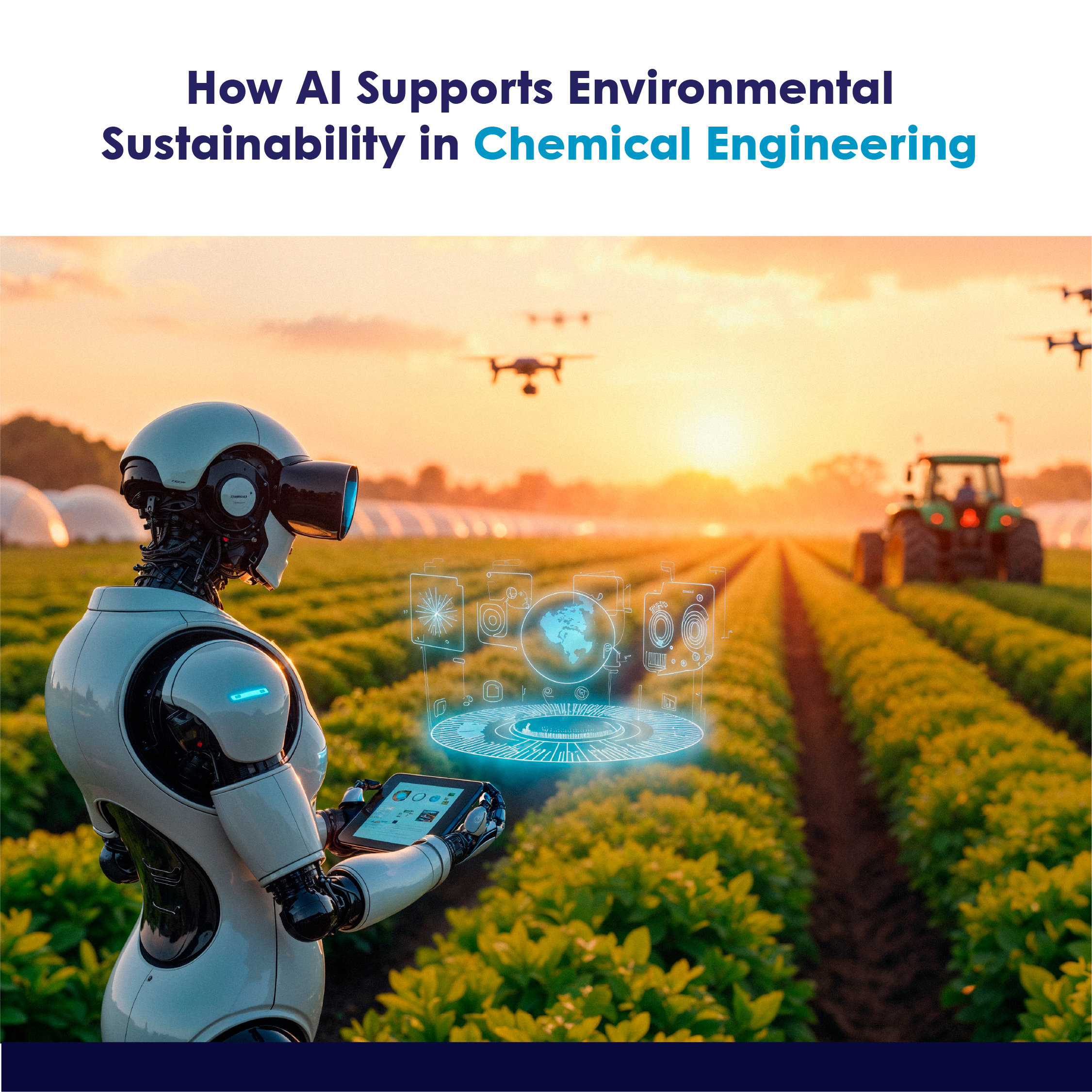
How AI Supports Environmental Sustainability in Chemical Engineering
Introduction
Climate change, pollution, and resource depletion are redefining how industries operate — and chemical engineers are at the center of that change. As the world transitions toward cleaner energy and responsible manufacturing, Artificial Intelligence (AI) is emerging as a critical tool for sustainability. At MIT Academy of Engineering (MIT-AOE), Pune, one of the leading B.Tech Chemical Engineering colleges in Maharashtra, students are learning how technology and environmental consciousness can work together to build a greener future.
What role does AI play in modern chemical engineering?
AI plays an important role in modern chemical engineering by improving efficiency, safety, and innovation across processes. It helps engineers analyze large datasets to optimize reaction conditions, reduce energy consumption, and improve product quality. AI models are used for process simulation, predictive maintenance, and real-time monitoring of industrial systems. In research, AI accelerates material discovery and chemical formulation by predicting outcomes before physical testing. It also supports automation and smarter decision-making in manufacturing plants. Overall, AI enables chemical engineers to design faster, cleaner, and more cost-effective processes while minimizing human error and operational risks.
Merging Chemistry with Intelligence
Chemical Engineering has always dealt with complexity — from balancing reaction kinetics to optimizing large-scale production systems. Today, with AI’s analytical power, those challenges can be addressed more efficiently and sustainably. By analyzing large datasets and simulating reactions, AI enables engineers to predict outcomes, minimize waste, and improve energy efficiency before a single experiment is performed.
At MIT-AOE, the Chemical Engineering program encourages students to adopt such data-driven thinking. While studying the core principles of chemistry and thermodynamics, students are also being introduced to digital tools that model and optimize chemical processes. This ensures they understand not just how reactions happen, but how to make them cleaner and safer.
AI in Sustainable Process Design
In modern process industries, AI supports green chemistry by optimizing every stage of production — from raw material selection to waste management. For example, algorithms can help determine the best catalyst for minimal emissions or identify ways to recycle heat within a system. AI models can even forecast how different production routes affect carbon footprints and environmental costs.
Through project-based learning, MIT-AOE students explore the application of these ideas in mini-projects and simulations. They learn how sustainable process design can be achieved through continuous monitoring, predictive control, and AI-assisted decision-making. This practical exposure helps bridge the gap between classroom theory and industry-scale sustainability practices.
Curriculum Grounded in the NEP Framework
MIT-AOE’s NEP-aligned curriculum ensures a balance between traditional chemical engineering and the integration of modern technology. Subjects such as chemical process control, reaction engineering, and energy systems provide a foundation for understanding industrial sustainability, while electives and seminars expand awareness of AI-driven process optimization and environmental management.
The institute emphasizes inquiry-based learning — students are encouraged to identify environmental challenges and propose research-oriented solutions. This approach cultivates a mindset of continuous innovation and responsibility toward nature.
Industry Exposure and Research Orientation
To make learning more relevant, MIT-AOE connects students with industry professionals through guest lectures, internships, and research collaborations. Learners gain perspective on how AI tools are transforming chemical plants — from real-time emission tracking to automated safety systems.
The institute’s focus on hands-on education ensures students are prepared to contribute to sectors like renewable energy, water treatment, pharmaceuticals, and materials engineering. By understanding sustainability challenges in these domains, graduates are ready to work in roles that combine chemical expertise with digital intelligence.
Career Prospects in AI-Driven Sustainability
- Process Optimization Engineers
- Environmental Analysts
- Research Scientists in Sustainable Materials
- Data Analysts for Green Manufacturing
As industries adopt cleaner technologies, professionals who understand both chemistry and computation are becoming indispensable. MIT-AOE ensures its students have the technical and ethical foundation to lead this transformation.
A Sustainable Future Through Education
The institute’s philosophy reflects a belief that innovation must always align with ecological balance. By teaching students to merge science, technology, and environmental awareness, MIT-AOE is shaping a generation of engineers who can design the sustainable industries of tomorrow.
Conclusion
Artificial Intelligence is not replacing chemical engineers — it is empowering them to think smarter, act faster, and innovate responsibly. At MIT-AOE, the convergence of AI and sustainable chemical processes gives students a clear sense of purpose: to create solutions that serve both humanity and the planet.
As one of the most forward-looking B.Tech Chemical Engineering colleges in Maharashtra, MIT-AOE demonstrates that the future of engineering is not only intelligent — it’s sustainable.
OUR RECENT BLOG