Mastering Computer Science, AI, and Robotics at MIT AOE
Engineering Careers & Future Skills
MIT AOE Computer Science and Engineering Programs
- Academic Offerings
- Key Features
- Technical Expertise
- Analytical Thinking
- Teamwork
- Programming Proficiency
Choosing the Right Specialization in Computer Science
- AI & Machine Learning
- Career opportunities in AI & ML
- Research and project-based learning
- Robotics Engineering
- Career pathways in robotics include
- Cybersecurity
- Cybersecurity roles
- Comparing CSE and ENTC
BTech and MTech Mastery at MIT AOE
Emerging Technologies and Skills at MIT AOE
Career Readiness and Industry Collaboration
Research, Projects, and Student Achievements
Faculty Mentorship and Support
Future Opportunities and Career Paths
Introduction
Welcome to the ultimate guide for students exploring MIT AOE Computer Science and its powerful blend of emerging tech and engineering education. If you’re curious about future careers in Artificial Intelligence, Machine Learning, Robotics, and Cybersecurity, you’re in the right place.
Engineering Careers & Future Skills
Engineering careers today are being reshaped by advanced computing and automation. According to the World Economic Forum, by 2025, more than 85 million jobs will be transformed by AI and automation. This makes skills in AI, ML, Robotics, and Cybersecurity critically important for aspiring engineers. Students with these skills are in high demand worldwide.
About MIT AOE
At MIT AOE, Pune, being one of India’s top autonomous engineering institutions, students build deep technical knowledge. The institute supports hands-on learning, mentorship, industry exposure, and much more to help you succeed in the academic sphere.
Here, you grow not just in technical skill, but also in innovation and leadership, qualities every tech career needs.
Who Should Read This Guide?
- Students exploring CS, AI, ML, and robotics programs
- Parents helping their children with specialization and career decisions
- Educators and career counselors guiding STEM aspirants
Read More: Understanding Robotics Through MTech Programs in Computer Science
1. MIT AOE Computer Science and Engineering Programs
At MIT AOE, the Computer Engineering Department offers both undergraduate (BTech) and postgraduate (MTech) degrees. These programs bridge the core computer science foundation with emerging fields like AI and machine learning.
1. Academic Offerings
- BTech Computer Science & Engineering — 4-year undergraduate degree with specializations in AI & ML, Data Science, and core CS fundamentals.
- MTech in Computer Science & Engineering — 2-year postgraduate specialization with advanced coursework and research opportunities.
Key Features
- Hands-on labs and real-time projects
- Faculty mentorship with seasoned researchers
- Industry-aligned curriculum
- Internship and placement support
The goal of these programs is to build technical expertise, analytical thinking, teamwork, and strong programming skills, everything you need to excel in the tech space.
2. Technical Expertise
- Builds a strong foundation in core computer science concepts and emerging technologies
- Helps students apply theory to real-world engineering problems
- Prepares learners for advanced roles in AI, ML, robotics, and cybersecurity
3. Analytical Thinking
- Trains students to break complex problems into structured, logical steps
- Improves decision-making through data analysis and problem evaluation
- Strengthens reasoning skills required for system design and optimization
4. Teamwork
- Encourages collaboration through group projects and laboratory work
- Develops communication and coordination skills across diverse teams
- Prepares students for real industry environments where teamwork is essential
5. Programming Proficiency
- Enhances coding skills through regular hands-on practice
- Builds confidence in using languages like Python, Java, and C++
- Enables students to develop applications, algorithms, and AI models effectively
Many students think MIT AOE focuses only on traditional computer science subjects like coding and theory. That’s not really the case. Along with strong CS fundamentals, the institute actively integrates AI, machine learning, and robotics into its curriculum.
Another common misconception is that emerging technologies are treated as optional or secondary. In reality, they are closely woven into core engineering education through projects, labs, and research work. So instead of learning basics first and innovation later, students at MIT AOE learn both together, in a way that matches what the industry actually expects.
Read More: Exploring MTech in Computer Science and Engineering
2. Choosing the Right Specialization in Computer Science
Selecting a specialization in CS can feel overwhelming. Let’s break down the main options and how they relate to your interests and future career goals.
2.1 AI & Machine Learning
Artificial Intelligence (AI) and Machine Learning (ML) are among the fastest-growing tech fields. These areas focus on building systems that learn from data and solve complex problems. According to Fortune Business Insights, the global AI market is projected to grow from $87.04 billion in 2022 to $1,811.75 billion by 2030.
MIT AOE’s AI & ML track covers foundational topics like deep learning, neural networks, and data analytics. This gives students the tools to build intelligent systems used across healthcare, finance, and automation.
Career opportunities in AI & ML:
- AI engineer: AI engineers design and build intelligent systems that can learn, analyze data, and automate decisions. They work on applications such as chatbots, recommendation engines, and predictive tools used in industries like healthcare, finance, and e-commerce.
- Data scientist: Data scientists analyze large datasets to uncover patterns, trends, and insights that support business and technical decisions. They use statistical methods, machine learning models, and data visualization to solve complex problems across domains.
- Deep learning specialist: Deep learning specialists focus on neural networks that mimic human learning. They develop advanced models for image recognition, speech processing, and natural language understanding, playing a key role in cutting-edge AI applications.
There are more career options, but the aforementioned are the most common.
Research and project-based learning:
Research and project-based learning play a central role in helping students connect classroom concepts with real-world applications. Instead of learning only through textbooks, students actively work on live projects, case studies, and research problems related to AI, robotics, cybersecurity, and core computer science. This approach improves problem-solving skills and encourages curiosity and innovation. By experimenting, testing ideas, and presenting outcomes, students gain a deeper understanding of subjects and build confidence. Research-driven learning also prepares them for higher studies, industry roles, and technology-focused careers where practical knowledge is just as important as theory.
Read More: Recent Advances in Artificial Intelligence and Machine Learning
2.2 Robotics Engineering
Robotics blends mechanical design, AI, and computer science. It powers everything from surgical robots to autonomous drones. Robotics engineers are behind the automation systems that boost efficiency in manufacturing, healthcare, agriculture, and logistics.
At MIT AOE, robotics learning emphasizes hands-on labs, real hardware building, and integrated AI systems. This prepares students to design autonomous machines that solve real problems.
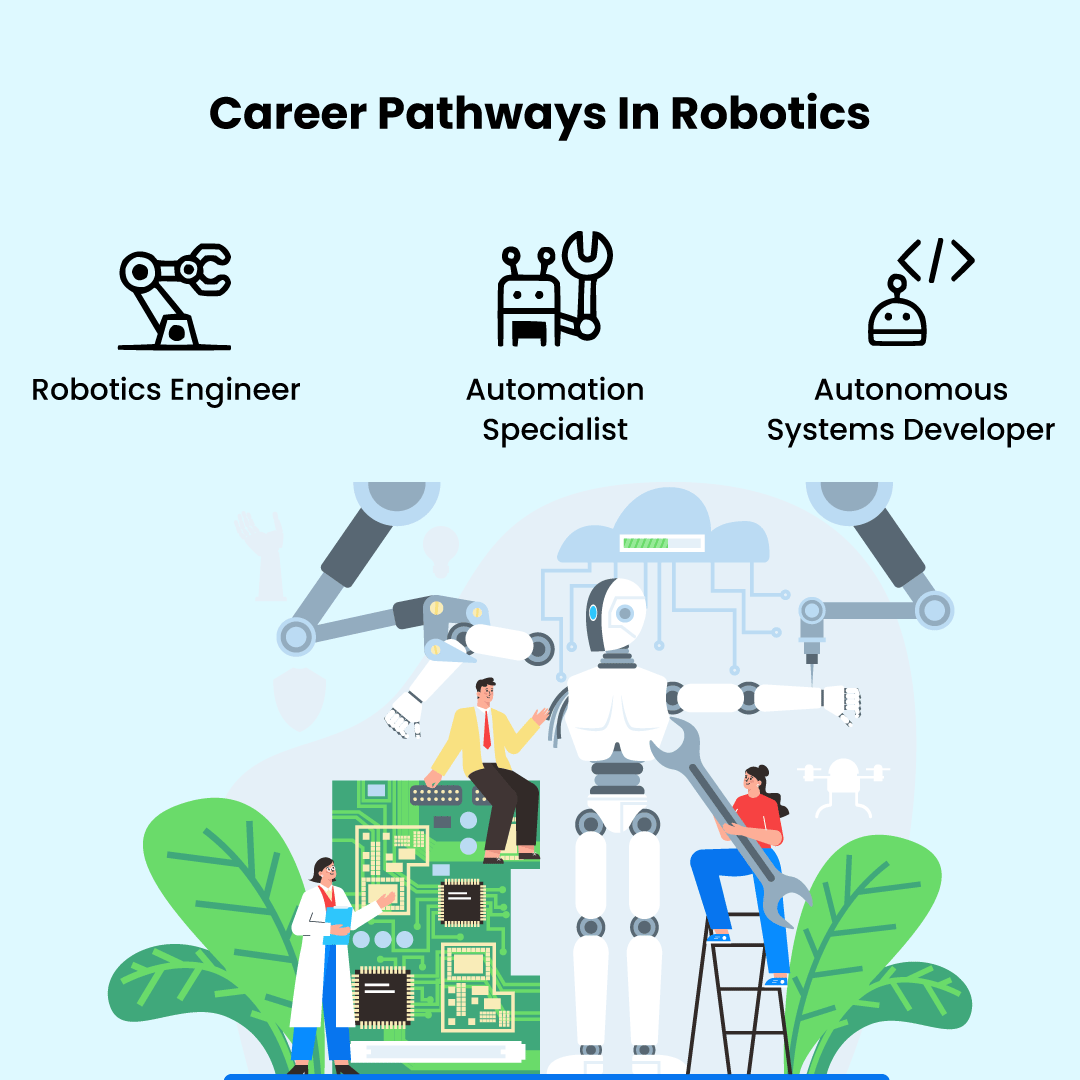
Career pathways in robotics include:
- Robotics engineer: Robotics engineers design, build, and test robotic systems that perform tasks with precision and efficiency.
- Automation specialist: Automation specialists focus on streamlining industrial and engineering processes using automated systems.
- Autonomous systems developer: Autonomous systems developers create intelligent machines that operate independently with minimal human control.
Read More: Understanding Robotics Through MTech Programs in Computer Science
2.3 Cybersecurity
Cybersecurity has become absolutely crucial. Companies everywhere face threats like data breaches, ransomware attacks, and network vulnerabilities. Students who specialize in cybersecurity learn how to protect systems using real tools and industry-proven techniques.
Cybersecurity roles:
- Security analyst: Security analysts monitor systems and networks to identify threats and vulnerabilities.
- Ethical hacker: Ethical hackers test systems by simulating real cyberattacks to find security weaknesses.
- Security consultant: Security consultants assess an organization’s overall security posture and recommend strategies to improve it.
2.4 Comparing CSE and ENTC
If you are confused between Computer Science & Engineering (CSE) and Electronics and Telecommunication Engineering (ENTC), you’re not alone. Here’s a quick breakdown:
- CSE focuses more on software, algorithms, AI, and computing systems.
- ENTC centers around hardware, signals, communication networks, and embedded systems.
Both have strong future potential. Your choice depends on whether you love code and data (CSE) or electronics and signal systems (ENTC).
Read More: CSE vs ENTC: Which is Right for You?
3. BTech and MTech Mastery at MIT AOE
BTech Computer Science
MIT AOE’s B.Tech. in Computer Science builds a solid foundation in programming, data structures, systems, and AI concepts. The curriculum also offers electives in ML, cloud computing, and cybersecurity. Graduates leave with practical skills to solve real engineering problems.
The MTech CSE program deepens your knowledge in advanced areas like big data, IoT, machine learning, and networking. Students also undertake research projects and industry collaborations. This prepares you for higher roles in tech or doctoral studies.
Read More: BTech Computer Science Mastery at MIT AOE
4. Emerging Technologies and Skills at MIT AOE
The tech world evolves fast. MIT AOE keeps pace by teaching cutting-edge skills that employers look for in 2026 and beyond.
Key Skills You Learn
- AI model development and deployment
- Machine learning and data analytics
- Robotics design and autonomous systems
- Cybersecurity defense strategies
- Internet of Things (IoT) systems
These skills are not just theoretical. You learn them through labs, projects, workshops, and real hardware. This makes you ready for high-impact careers from day one.

5. Career Readiness and Industry Collaboration
MIT AOE partners with industries to give students real exposure and professional readiness. Students receive help with internships, placement prep, and professional skills training.
- Over 200+ companies visit the campus for placements every year.
- Students participate in internships that boost real-world experience.
- Industry mentors guide final year projects and placements.
Read More: Electronics and Telecommunication Engineering: A Roadmap to AI & ML Careers
6. Research, Projects, and Student Achievements
MIT AOE encourages a research culture and technical innovation. Students take on projects in AI, robotics, cloud computing, and cybersecurity. Many present their work at conferences and technical competitions. This experience builds confidence, innovation skills, and real technical strength.
Read More: Understanding Robotics Through MTech Programs in Computer Science
7. Faculty Mentorship and Support
At MIT AOE, experienced faculty members guide students from the first day. Faculty support helps you tackle tough concepts, choose good projects, and develop leadership. Mentorship shapes not just your skills, but your confidence and professional mindset.
Read More: B.Tech Computer Science Mastery at MIT AOE
8. Future Opportunities and Career Paths
When you complete CS or related programs at MIT AOE, a world of opportunities opens up:
Career paths include:
- AI researcher
- Robotics developer
- Cybersecurity expert
- Software engineer
- Data analyst
- Cloud solutions architect
Many students also choose higher studies like PhD programs or build startups in AI and ML. You can even become an entrepreneur and solve real societal problems through technology.
Read More: How to Choose the Right Specialization in CS Engineering
Conclusion
MIT AOE plays a significant role in driving CS success, career growth, and readiness for emerging technologies. The institute offers comprehensive pathways for students to build strong foundations in computer science while gaining advanced exposure to artificial intelligence, machine learning, robotics, and cybersecurity. This integrated approach ensures academic excellence alongside practical learning, helping students develop industry-relevant technical skills.
Beyond technical training, MIT AOE focuses on leadership, innovation, and problem-solving. Through research-driven projects, internships, and industry interactions, students gain valuable exposure to real-world engineering challenges. These experiences prepare them not only for high-demand technology roles but also for higher studies and entrepreneurial opportunities.
The institute’s supportive learning environment encourages students to explore their interests, collaborate with peers, and learn under the guidance of experienced faculty. Advanced laboratories, student-led initiatives, and research centers further enhance holistic development in CS and AI fields. By combining knowledge, application, and mentorship, MIT AOE prepares students to adapt and grow in a rapidly evolving technology landscape. Students are encouraged to explore MIT AOE programs, faculty expertise, research labs, and student resources to confidently shape their future in technology.
OUR RECENT BLOG