
Modern Electronics & Telecommunication Engineering Career Paths
1. What is the Real Scope of Electronics & Communication Engineering Today?
2. What Expanding Opportunities Exist Across Industries?
3. What Are the Skills Required for Future Electronics Engineers?
4. Which Technical Skills Do Modern ECE Professionals Need?
5. What Soft Skills Actually Matter for Career Growth?
6. How Are Emerging Technologies Reshaping ECE?
7. What Is the Role of AI and Automation in ECE?
8. Which Technologies Are Shaping the Future of the Industry?
9. Why Do Advanced Learning and Specialisation Matter in ECE?
10. Why Should You Specialise Rather Than Stay General?
11. Which Specialisations Are Most In-Demand Right Now?
12. What Are the Career Opportunities After M.Tech in ECE?
13. How Should Electronics Engineers Prepare for a Future-Ready Career?
14. What Steps Should You Take Right Now?
15. How Do You Stay Relevant as the Industry Keeps Evolving?
16. Building a Successful Career in Modern Electronics & Communication Engineering
Introduction
Think about every device that shapes your day: your smartphone, the traffic signal that adjusts in real time, the medical scanner at your hospital. All of it runs on electronics and communication engineering. Over the past decade, ECE has shifted from analogue circuits and fixed-line networks to AI-powered embedded systems, 5G infrastructure, IoT ecosystems, and semiconductor innovation.
If you are an aspiring engineering student, a diploma holder considering lateral entry, or a parent helping your child choose the right path, this guide is written for you. It breaks down what ECE looks like today, which skills matter, which technologies are reshaping the field, and how to build a career that actually lasts.
What is the Real Scope of Electronics & Communication Engineering Today?
What Expanding Opportunities Exist Across Industries?
The BTech ECE scope today spans industries you might not have initially considered. ECE engineers are driving automotive electronics, building healthcare wearables, designing aerospace radar systems, and powering smart infrastructure. If you are trying to decide whether ECE is the right branch, ask yourself: do you want to work on hardware, software, or somewhere in between? ECE gives you all three entry points.
According to a career-scope analysis, India could see 345,800+ jobs in ECE by 2026, growing at roughly 7% annually . That is a significant pipeline for graduates entering the market right now.
What Are the Skills Required for Future Electronics Engineers?
Knowing which skills to build early can save you years of catch-up later. The skills required for electronics engineers in 2026 fall into two equally important categories.
Which Technical Skills Do Modern ECE Professionals Need?
- Circuit design and embedded systems development
- Programming in Python, C, and C++ for hardware applications
- VLSI design, PCB layout, and simulation tools such as MATLAB and Cadence
- Networking protocols, communication systems, and IoT fundamentals
- Data analytics and AI integration in electronic systems
What Soft Skills Actually Matter for Career Growth?
ECE advancements depend as much on how engineers communicate ideas as on what they build. Employers consistently value analytical thinking, clear communication, collaborative teamwork, and cross-disciplinary project management.
The World Economic Forum's Future of Jobs Report 2025 identifies AI and big data as the fastest-growing skills globally, with 85% of employers planning to prioritise upskilling. If you are wondering which electives to pick or which side projects to pursue, let that data guide you. At MITAOE, our curriculum for advancing careers in electronics engineering is designed around exactly these industry signals.
How Are Emerging Technologies Reshaping ECE?
What Is the Role of AI and Automation in ECE?
The role of AI in electronics and communication engineering is reshaping the field from within. AI in electronics engineering is enabling smarter embedded systems, self-optimising networks, and real-time predictive signal processing. AI tools automate VLSI circuit layout and optimisation, cutting time-to-market for advanced chips. In communication networks, AI analyses traffic patterns and dynamically optimises bandwidth, reducing latency significantly.
Which Technologies Are Shaping the Future of the Industry?
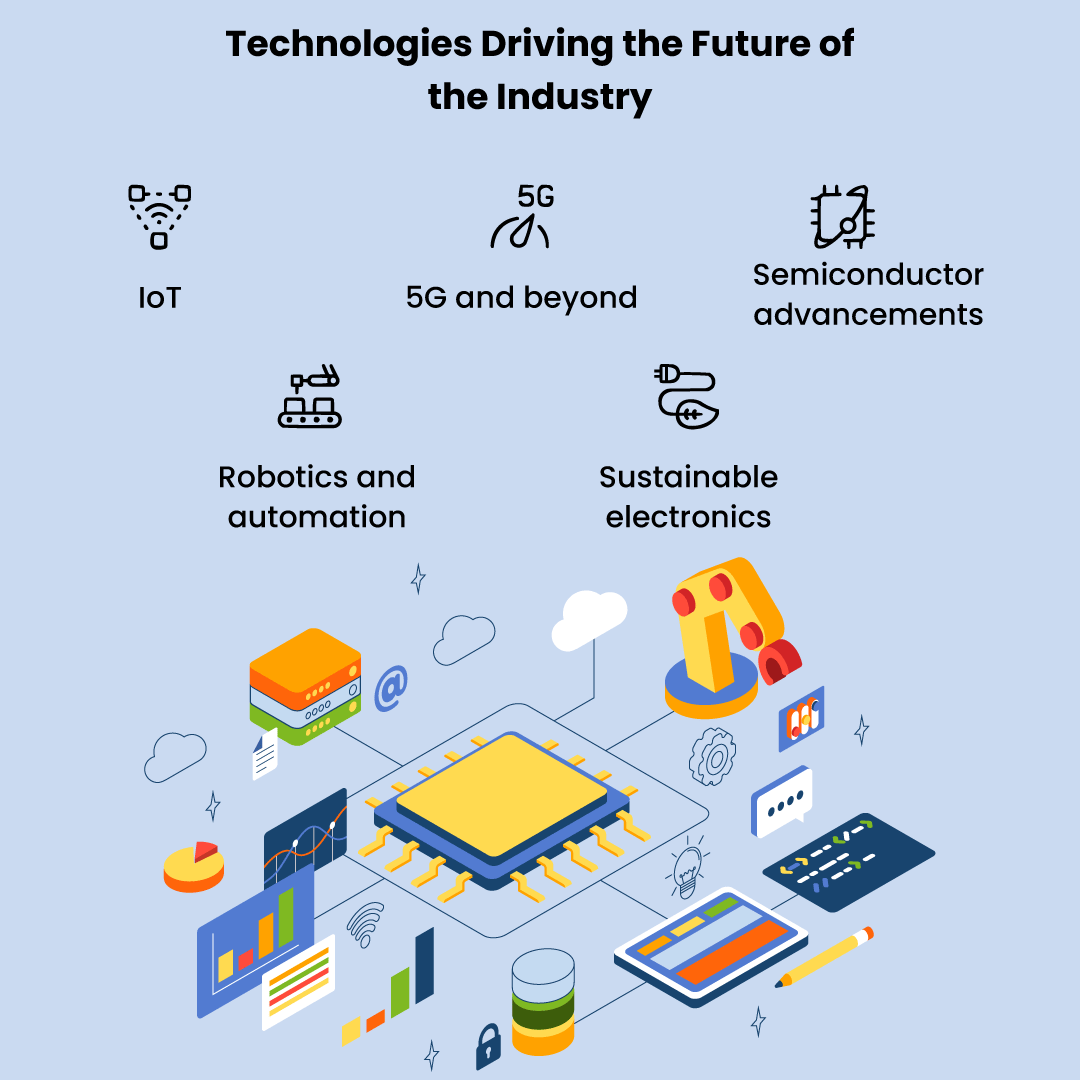
- IoT: Connected ecosystems linking homes, factories, and smart cities
- 5G and beyond: 6G research is targeting ultra-low latency, terabit-level speeds, and deep AI integration
- Semiconductor advancements: VLSI innovations delivering faster, smaller, and more energy-efficient chips
- Robotics and automation: AI-driven systems handling repetitive industrial processes at scale
- Sustainable electronics: Green engineering solutions addressing energy efficiency and e-waste
For students wondering how these technologies translate into job roles, our article on how to advance a career in electronics engineering at MITAOE maps these trends directly to career pathways worth exploring.
Why Do Advanced Learning and Specialisation Matter in ECE?
Why Should You Specialise Rather Than Stay General?
Here is an honest answer: generalist ECE knowledge gets you in the door. Specialisation is what gets you promoted, published, or recruited by leading firms. The MTech electronics engineering benefits go well beyond a postgraduate certificate. They represent a commitment to niche expertise, which is exactly what competitive industries are paying for today.
Advanced electronics engineering courses give you the depth to solve real engineering problems, lead R&D teams, and publish credible research. If you are weighing whether to pursue an M.Tech after your B.Tech, the answer depends on your career goal. Targeting research or senior technical roles? M.Tech is the right move.
Which Specialisations Are Most In-Demand Right Now?
| Specialisation | Career Roles | Key Industries |
|---|---|---|
| VLSI & Semiconductor Technology | Chip designer, FPGA engineer | Semiconductor, defence, consumer electronics |
| Embedded Systems & IoT | Firmware developer, IoT architect | Automotive, healthcare, smart cities |
| Communication Engineering | RF engineer, network architect | Telecom, aerospace, 5G infrastructure |
| Robotics & Automation | Robotics engineer, control systems specialist | Manufacturing, healthcare, defence |
| AI & ML in ECE | AI systems engineer, signal processing specialist | Tech firms, research labs, telecom |
| Signal Processing | Audio/image processing engineer | Media, medical devices, surveillance |
What Are the Career Opportunities After M.Tech in ECE?
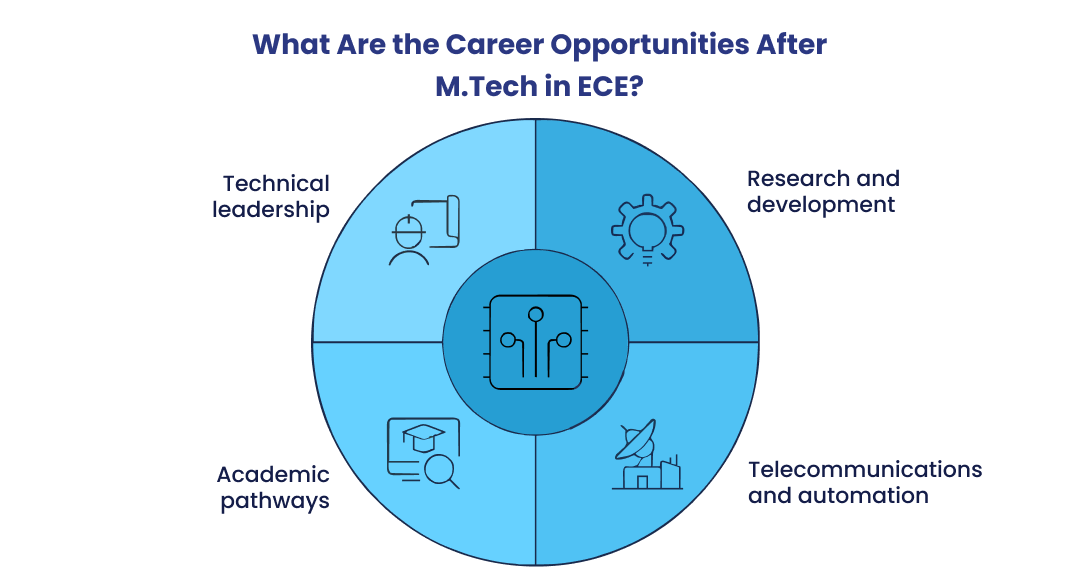
Career opportunities after MTech ECE are genuinely broad. An M.Tech degree signals deep technical ability and research aptitude, opening doors that a B.Tech alone often cannot.
Electronics engineering career opportunities after M.Tech include:
- Research and development: With semiconductor firms, national laboratories, and product companies
- Telecommunications and automation: System design in 5G infrastructure, smart grids, and industrial control
- Academic pathways: Lectureships, research fellowships, and PhD programmes
- Technical leadership: Senior engineering roles, consultancy, and innovation management
The best M.Tech programmes combine research depth with industry exposure through real-world projects, advanced labs, and live industry collaborations. At MITAOE, we have mapped out exactly what career options open up after engineering at every stage, from fresh graduate to postgraduate, so you can plan rather than guess.
How Should Electronics Engineers Prepare for a Future-Ready Career?
What Steps Should You Take Right Now?
The future scope of electronics and communication engineering in India is strong, but it rewards those who prepare deliberately. Whether you are in your first year or about to graduate, these steps make a tangible difference:
- Choose a specialisation aligned with where industry demand is heading
- Build a portfolio through internships, projects, and open-source contributions
- Participate in hackathons, innovation challenges, and inter-collegiate competitions
- Pursue relevant certifications alongside your formal degree
How Do You Stay Relevant as the Industry Keeps Evolving?
ECE career opportunities will keep shifting. What the job market needs in 2030 will differ from today. To stay ahead: commit to continuous learning, structured online courses, professional networking, and active engagement with new engineering tools. Our resource on career advancement in electronics engineering at MITAOE outlines a practical roadmap, from your final year through your first decade of work.
Building a Successful Career in Modern Electronics & Communication Engineering
ECE is one of the most dynamic and future-proof engineering disciplines available to students today. From VLSI and AI-integrated embedded systems to 5G networks and robotics, the range of pathways is genuinely broad. The engineers who build lasting careers in this field combine technical depth with adaptability and a commitment to continuous learning. Whether you are starting with a B.Tech or planning an M.Tech, your choices about specialisation and skills will matter far more than your branch name alone.
At MIT Academy of Engineering, Pune, our Electronics and Communication Engineering programmes are built with this reality in mind: industry-oriented, research-driven, and structured to develop engineers who lead.
Frequently Asked Questions
What is the future scope of electronics and communication engineering in India?
Very strong. With 5G rollout, India's semiconductor manufacturing push, and rising demand for IoT and embedded systems professionals, ECE graduates have access to growing opportunities across telecommunications, automotive, defence, and healthcare.
Which ECE specialization has the highest career potential right now?
VLSI and semiconductor technology, embedded systems with IoT, and AI-integrated electronics are currently most in-demand. Choose based on where your interests meet industry growth trends.
Is M.Tech in ECE worth pursuing?
Yes, especially if you are targeting R&D, senior technical, or academic roles. It provides niche expertise and research credibility that significantly strengthens your career trajectory.
What technical skills should ECE students build in 2026?
Embedded programming, VLSI tools, PCB design, IoT platforms, Python, and foundational AI and machine learning applied to electronic systems.
How is AI changing electronics and communication engineering careers?
AI is generating new roles in intelligent system design, network optimisation, and signal processing, while raising the technical bar for existing ECE roles across every industry.